A shared mobile codebase is useful only if it removes duplicated work without taking release decisions away from individual products. Put reusable behavior behind feature contracts, keep app identity and assembly explicit, and test every app affected by a shared change. One repository can support several releases; it cannot make shared changes risk-free.
A shared repository is not a shared release
In a November 2026 case study, a developer describes six separately listed Google Play apps built from one Kotlin Multiplatform repository. The iOS builds also come from that repository, but their App Store releases were still forthcoming when the account was written. It is an example of one implementation, not evidence that consolidating six apps produces a particular saving for a larger team.
The useful distinction is between three decisions that often get bundled together: which behavior to implement once, which product owns an experience, and when each product publishes. Those decisions need not have the same boundary. Two apps may share account-management behavior while using different navigation, integrations, data tenants and release approvers. Conversely, two apps with different icons may be so similar that separate listings are the wrong product decision.
Independent publication also has limits. A breaking change to a shared library, a repository-wide dependency upgrade or an incompatible backend change can hold up multiple apps even when each has its own pipeline. The goal is not to promise that one app can never affect another. It is to make the impact visible before merging and leave each product owner in control of publication.
Decide whether these should be separate apps first
Do not start by choosing a module layout. List the audience, capabilities and operational owner of each proposed app. A product serving a distinct workflow with different integrations may justify its own store record. An otherwise identical product with a different region name may not. Where the differences are mostly configuration, compare separate listings with one app that varies its experience after sign-in or region selection.
This question matters particularly on iOS. Apple’s App Review Guideline 4.3 warns against multiple bundle IDs for what is effectively the same app, including location-specific duplicates. Separate binaries, assets and pipelines do not establish that near-identical regional or client apps deserve separate listings. Review is an external decision; no module structure guarantees acceptance.
If separate iOS products are justified, plan their identities early. Apple identifies an App Store app by its bundle ID, which cannot be changed after a build is uploaded. On Android, the applicationId identifies the installed app; changing a published app’s ID makes Google Play treat the upload as a new app. A consolidation that preserves code but loses an existing identifier is not a routine refactor. It changes the product’s distribution path.
For an existing portfolio, inventory store records and identifiers before touching build files. If a listing has users, preserving its identity should be an explicit migration constraint. If a proposed listing has no distinct audience or experience, challenge it before paying for another shell, signing setup, store presence and release process.
Put features in libraries and product decisions in shells
A useful dependency rule is app shell → selected features → shared core. The app shell is the entry point: it selects features, connects root navigation and supplies product-specific configuration. A feature exposes a narrow contract and does not reference the app that happens to host it. Shared core holds lower-level behavior that genuinely has the same meaning across consumers.

That division matches Android’s modularization guidance, which describes feature modules as related screens and app modules as entry points that select features. The guidance favors low coupling and high cohesion, not a universal module count. The six-app case study reports 99 Gradle modules and the same dependency direction. That number describes the author’s repository; it is not a target for a smaller portfolio.
Put app identity, selected navigation paths, theme, optional surfaces and integrations at the assembly boundary. Keep signing and publication credentials under each app’s release ownership. A shared feature should accept the capabilities it needs through an explicit API rather than inspect an app name and branch throughout its implementation. Otherwise every new product variation turns shared code into a growing catalogue of exceptions.
Treat tenant and region selection as data-boundary decisions, not branding. A shared account screen can render the same UI while reading from different backends or handling different stored data. Make the endpoint, tenant context and credential source explicit at the boundary. Test with different tenant accounts and stored data so that reuse does not silently cross an isolation boundary.
Start with one feature used by at least two apps and changed often enough to make duplication costly. Extract its behavior and tests, then have each shell assemble its own navigation and integrations. Build an app that deliberately omits the feature and inspect its dependencies: if the omitted feature’s integrations still arrive, the boundary is weaker than the diagram suggests. For teams retaining separate native products, a bounded shared-logic pilot may be a better first step than consolidating entire apps.
Choose flavors or separate app modules for the actual portfolio
Do not reject Android product flavors on the claim that they cannot produce distinct apps. Android supports separate Google Play listings through flavors with distinct application IDs, and flavors can have their own version settings. The choice between flavors and separate thin app modules is about how cleanly each structure represents the portfolio.
Flavors are worth testing when apps largely share their feature set and differ through a manageable amount of configuration. Separate app modules become more compelling when products select substantially different features, need different dependency graphs, or have configuration owned by different teams. They can make assembly boundaries clearer, but they also add build and maintenance work. Neither approach fixes a poorly defined feature contract or an unclear data boundary.
Compare them using a representative slice rather than a theoretical architecture exercise. Implement two real app variants both ways. Inspect their manifests, resulting artifacts and dependency graphs. Check whether a change intended for one product is easy to keep out of the other. Record the build and maintenance effort involved in making the same change. If flavors express the differences cleanly, keep them; separate modules are not a badge of architectural maturity.
The same discipline applies when choosing a cross-platform framework. React Native’s platform-specific APIs help distinguish iOS from Android behavior. They do not answer whether two products should share a screen, backend or release schedule. Platform reuse and product reuse are separate design decisions.
Build broadly; release narrowly
CI should have two gates. The merge gate asks whether a shared change is safe for every affected app. The publication gate asks whether a particular product owner is ready to ship that app’s signed artifact. Conflating those gates turns a convenient shared pipeline into a forced release train.
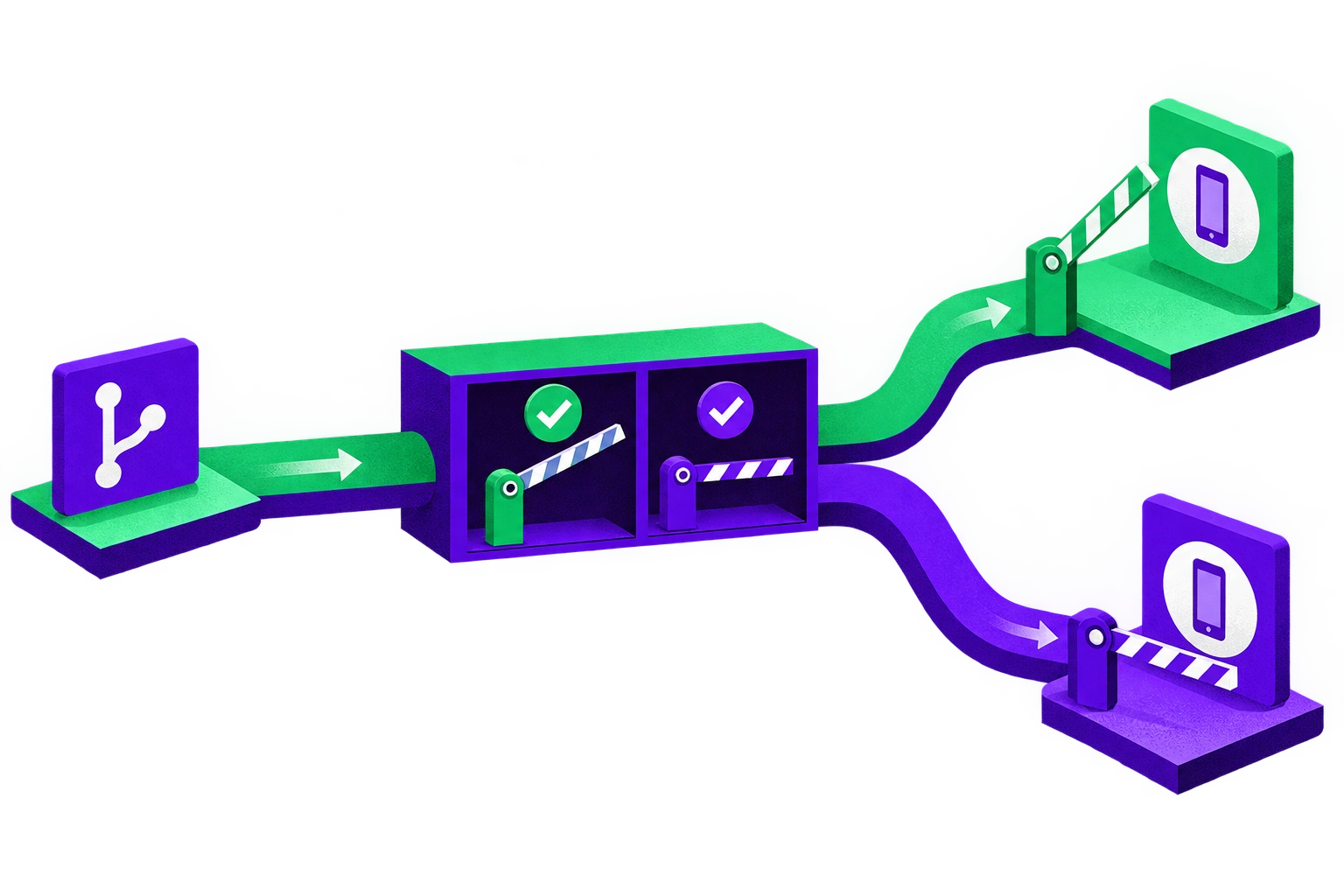
The case-study author reports building all six Android shells on pull requests because a shared change can break a shell the flagship build never exercises. They also report 373 tests across 15 modules, with shared tests running on pull requests. Those tests are valuable, but their count says nothing by itself about configuration errors or cross-app regressions. For each affected app, test the assembled artifact, relevant configuration and a critical journey alongside shared feature logic.
Publication can reuse procedure without sharing a trigger. GitHub Actions reusable workflows accept caller inputs and secrets. The case study describes separate version keys and tag prefixes for six thin callers of one release workflow. That is a sensible division: standardize repeatable build-and-publish steps, then let each app supply its identity, signing material, version and approval decision.
Pay particular attention to Android versions. versionName is user-facing; versionCode is an integer used for release ordering. A successive release needs a higher versionCode, and Google Play does not accept reuse of a previously uploaded code. A shared GitHub Actions run number is not automatically a safe counter for several independently published apps. Track each app’s uploaded history and validate its next code before publication.
A staged rollout is not a substitute for compatibility work. Apple’s phased release spreads an approved update across increasing percentages of eligible automatic-update users over seven days, but users can still download it manually. It controls one app’s update; it does not protect another app from a shared backend change. Exercise an older app against a newer backend, and give each app an explicit rollback or disablement plan.
Pilot one extraction before consolidating the portfolio
Use one representative change to decide whether more sharing is justified:
Map the current products. Record each applicationId or bundle ID, store record, signing owner, audience, feature set, backend, data tenancy, analytics, monetization, version history and release approver. Mark identifiers that must survive consolidation.
Draw three ownership boundaries. Separate shared feature contracts and behavior; per-app assembly and configuration; and data, credentials and release authority that must remain isolated.
Extract one duplicated feature. Give it a narrow API and tests. Assemble it in two apps, and confirm that an app omitting it does not pull in its dependencies.
Compare the build options. For Android, try flavors and separate shells against the same representative slice. Inspect manifests and artifacts rather than assuming one structure is inherently safer.
Run two independent releases. Build every affected consumer at merge time, then version, sign, approve and publish each app separately. Test tenant isolation and older-app backend compatibility before either publication.
Measure the result. Compare total engineering time for the change, cross-app defects, CI time, release lead time and blocked releases. Expand the shared surface only if those measures improve without weakening product teams’ ability to choose when they ship.
If the inventory exposes tangled identities, data boundaries or release ownership, a staged mobile app architecture assessment is more useful than moving every app into one repository at once.