A migration can copy every field correctly and still change the decision a product makes. Before selecting a replacement platform, find out what consequential consumers believe the data means, when they expect it, and how they detect that it is incomplete. Those guarantees—not the table definitions—should determine the migration plan.
A copied dataset can still break its consumers
Consider a hypothetical stock-availability API. Its existing feed represents stock after an overnight reconciliation. A new pipeline publishes live stock updates. Both versions have the same product identifiers, quantities and column types. The new data is arguably more current. But if the API’s availability rule assumes reconciled stock, switching feeds changes what customers can order. Perfect field mapping does not settle whether that change is acceptable.
This is the distinction between copying values and preserving a consumer contract. The contract includes business meaning, inclusion rules, corrections, delivery deadlines and what happens when a record is absent. Some of those rules may exist only in scheduled jobs, application code or the habits of people who correct exceptions.
In Tesco’s account of its technology transformation, historically separate retail stacks lacked a single source of truth for stock or pricing. The speaker names clear data pathways and data quality at each step as principles of the resulting platform. That illustrates the assessment problem: a proposed destination cannot resolve ambiguity about authority or meaning by itself. It does not establish that Tesco followed the audit method proposed here.
Nor should an assessment preserve every quirk it finds. An undocumented delay might protect a business rule, or it might be an avoidable defect. The workflow owner needs to decide which observed behaviors become explicit guarantees, which change deliberately, and which need more investigation.
Start at consequential consumers, then trace upstream
Do not begin with an enterprise-wide lineage inventory. Pick two or three datasets whose failure would change the modernization decision. Stock availability, order status and a finance export are useful candidates because they can expose real-time, batch and manually corrected paths. The exact selection should follow business consequence, not technical convenience.
For each dataset, identify the report, API or operational decision that uses it. Then work backward: which query reads it, which copy supplies that query, which transformation or scheduled job populates the copy, where manual overrides enter, and which producer originated the data? Name the authoritative owner at each boundary. Attach evidence such as queries, job configuration, code and observed runtime behavior. Mark an unverified hop as a gap rather than drawing a confident arrow through it.
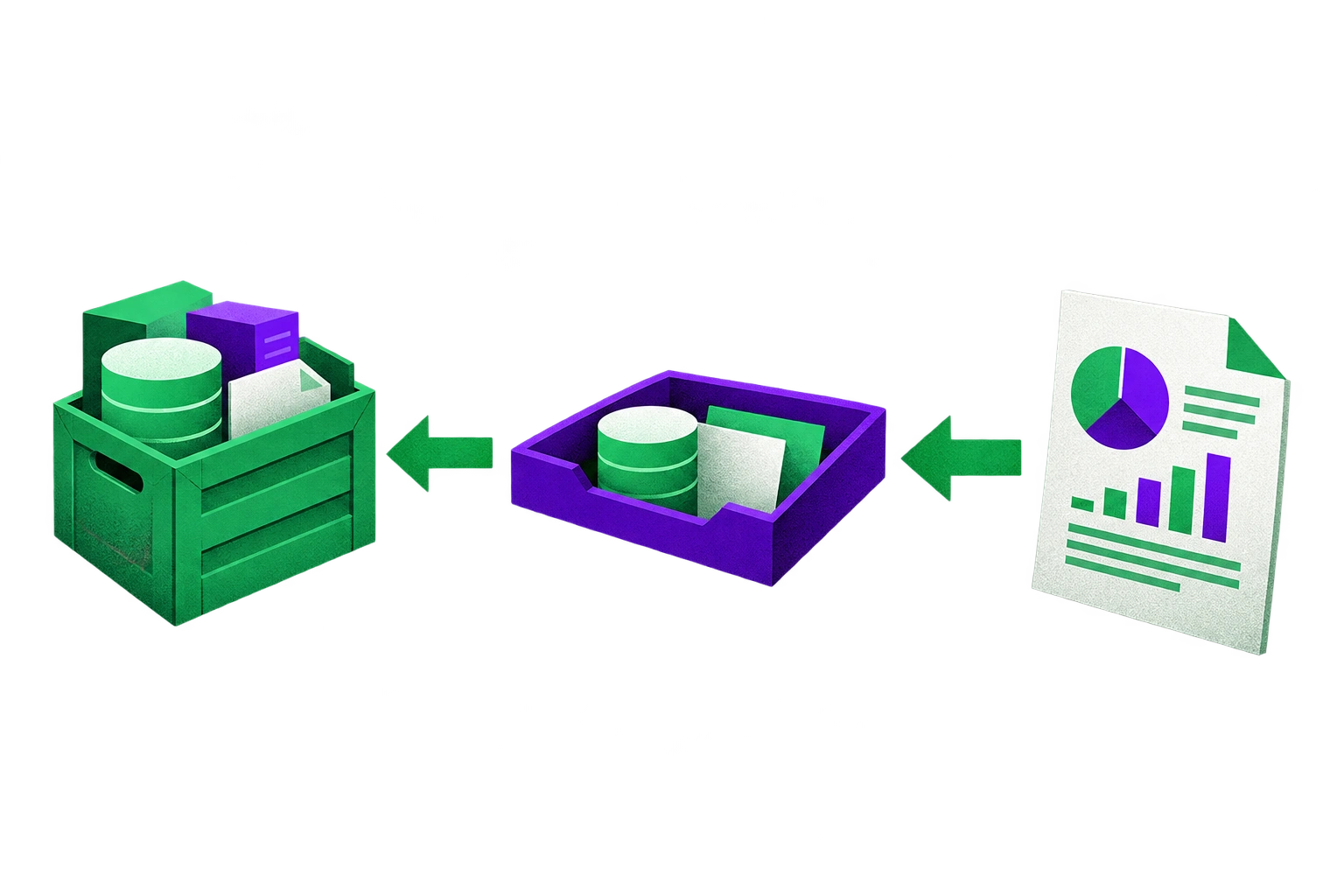
dbt exposures can record a dashboard’s dependencies on models, sources and metrics. They are a useful lead for discovery, not an inventory of consumers outside the documented dbt project. Look for application reads, exports and operational work that the lineage tool cannot see. As with architecture diagrams in modernization work, the map becomes useful when checked against actual jobs and integrations rather than treated as proof on its own.
Record the assessment boundary. If the team traced the finance export but not every spreadsheet derived from it, say so. A bounded map with explicit unknowns is more useful for a platform decision than a comprehensive-looking diagram whose edges nobody verified.
Agree on guarantees before designing the replacement
At every consequential producer–consumer boundary, ask what a usable result means. What is the grain: a product at a location, an order, or an order event? Which identifier survives corrections? Which records belong in a result, and which are excluded? Can historical values change? When must an update be visible, and where is that deadline measured—from a producer event, a completed job, or a consumer read? Who owns a late or incomplete delivery?
Also ask what the consumer is permitted to do with the data and which changes would require coordination. Harrer and Wider’s data-contract discussion frames meaning, freshness, completeness, permissible use and stability as contract questions, not just schema questions. These questions are especially important when several consumers use the same field for different decisions.
A compact guarantee register is enough to start. For each dataset and consumer, capture:
Business meaning, owner, key and grain.
Inclusion, exclusion and historical-correction rules.
Completeness rule, freshness deadline and measurement point.
Allowed changes and access or use restrictions.
Verification query or test, incident response, confidence level and open questions.
Keep two columns in the working record: observed behavior and agreed future guarantee. For the hypothetical stock API, engineers might observe that a manual correction reaches the current feed only after reconciliation. The workflow owner might approve that delay, reject it, or ask for evidence about its consequences. Writing the observation straight into a new platform specification would silently make the decision for them.
The Open Data Contract Standard repository identifies v3.2.0 and separates schema, data quality and service-level agreements. It is a possible format for an approved contract, not a prerequisite for finding one. A reviewed register may be the better first deliverable. Likewise, a contract document does not run its own checks: someone must implement, schedule and monitor them.
ODCS quality rules can express null counts, invalid values, duplicate compound keys, row counts and SQL checks. Its SLA specification prefers latency over freshness as a property name and can include an element, schedule and business driver. The vocabulary matters less than agreeing on a measurement a consumer can challenge. Do not copy a sample threshold into production without that agreement.
Test each promise with the right evidence
Different checks answer different questions. Row reconciliation asks whether corresponding values were copied. A business-output comparison asks whether the old and new paths produce an acceptable result for a consumer. A quality rule asks whether data meets a stated content condition. A lag measurement asks whether it arrives before the agreed deadline. Passing one does not imply passing the others.
dbt’s enforced model contracts check column names and types at build time; constraint enforcement depends on the platform. dbt distinguishes those shape guarantees from data tests for content. A passing model contract will not establish that an order-status report applies the right exclusions or that a correction arrives on time.
AWS DMS validation compares source and target rows and reports mismatches. That is valuable migration evidence, but validation queries also consume source, target and network resources. Budget for that load rather than assuming reconciliation is free. Even a complete row match cannot prove that a downstream report still uses the intended business definition.
Check the timing of the validation mechanism against the consumer’s deadline. For AWS DMS CDC validation with S3 targets, validation runs once daily at 00:00 UTC, and the documentation notes possible false errors near the interval boundary. The presence of a validation feature therefore does not establish a suitable freshness check for a time-sensitive consumer.
Run a bounded rehearsal with an agreed source-and-target comparison point or watermark. Test selected consumer outputs and exception cases as well as row equality. Measure replication lag at the point the consumer actually reads. Document expected differences before comparing: parallel paths observed at different times can disagree without either being defective. Unexpected differences need an owner and a disposition, not just a dashboard count.
Sequence the move around contracts that can survive
Choose one dataset and a bounded consumer cohort for the first migration. Establish its owner and executable checks before changing reads. Decide which path accepts authoritative writes, how old and new readers will coexist, and whether the old path can interpret writes made after cutover. If it cannot, rollback requires more than switching an endpoint back.
Where safe, run old and new consumer outputs side by side within a defined comparison window. Set stop conditions in advance: for example, an unresolved difference in a decision-critical output, a failed completeness rule, or lag beyond the approved deadline. Move the cohort only after its owner accepts both the intended changes and the remaining uncertainty. Keep the rollback path executable until the old readers are retired or otherwise protected from incompatible writes. Parallel operation costs infrastructure and attention, so give it a purpose and an exit condition.
Directly sourcing from an upstream system may remove a slow legacy hop, but it is not automatically safer. The Revert to Source pattern calls for tracing sources and downstream destinations beyond the legacy boundary. It works best where legacy adds little enrichment; two-way flows and source-system capacity need particular care. If legacy applies a material correction, bypassing it requires an agreed replacement rule, not merely a faster connection.
Replacement should also be allowed to lose. If the assessment finds that the main problem is one fragile job with clear ownership and testable outputs, fixing that pipeline in place may carry less risk than moving its consumers. If important guarantees remain unknown, delay the replacement decision rather than treating missing evidence as permission to proceed.
Put a decision-ready assessment in front of the CTO
The deliverable should make choices possible, not just describe the current estate. Include an evidence-linked map for the selected datasets, the guarantee register, unresolved questions with owners, and options with dependencies: repair in place, investigate before replacing, or run a staged pilot. Give the pilot explicit go/no-go criteria, a comparison window, acceptable differences, stop conditions and a rollback test.
An independent code audit and technical assessment can help establish that evidence across APIs, data flows, integrations and critical workflows. It should produce a prioritized diagnosis, not claim to certify every undocumented consumer.
Before authorizing the next migration slice, check that the team can answer:
Which consumer decision is at risk, and who approves its future behavior?
Where did each guarantee come from: code, runtime evidence or owner agreement?
Which consumers and paths remain unverified?
Which checks prove copied values, business outputs, completeness and delivery time separately?
What would stop the cutover, and has rollback been exercised against the current write path?
If those answers are missing, the next step is a narrower assessment—not a larger target-platform diagram.